
gardens@dufferinpark.ca, or
sign up: our email list service (dufferingrovefriends),
or website forum.
For the basics, see
- Website & Privacy Policies
- How To Get Involved
- The Role of the Park
If you love gardening, you can pitch in with the community gardens at Dufferin Grove Park (both food and decorative plants), or get your own city allotment garden plot (from the City not in Dufferin Park) for a small fee.
All of Dufferin Grove Park's vegetable, native and flower gardens are community gardens. If you'd like to help keep them healthy and happy this summer or if you just want to get your hands dirty then leave a message at the rink house for the Jenny Cook of the park staff. 416-392-0913.

Park Gardens (Main)
Scanning...
on this page:
Park Gardens | Latest News | Related Links
Welcome to park gardens. If you want to participate in gardening at the park or in the maintenance of this website, or if you have any questions or comments, please contact gardens@dufferinpark.ca.
In spring you can help seed, water, turn soil, then it is weeding time and finally harvest time!
Gardening work bulletin board 2010Rachel Weston, August 31, 2010Hey y'all, Again not a lot to report in the gardens this week with only one full gardening session but things are looking good for the most part. Tomato plants are heavy with fruit that is ripening faster than we pick it, the late season crops of rapini, tatsoi and chard are coming along and the edamame beans are looking cute and fuzzy. In the flower gardens there are still plenty of blooming black eyed susans, 4 o'clocks, morning glories and sunflowers and in the native areas there are lots of yellow flowers on the wingstems, cupplants and goldenrod, and some beautiful purple flowers on the joe pye weed, ironweed, and blue vervein. We'll soon be seeing a much bigger splash of purple around the park when all of the asters start to bloom. This week there will be weeding, watering and harvesting to do in the veggie gardens, weeding around the firepit where we planted a bunch of marigolds a few weeks ago, maintenance on the cob green roof, and tidying up some of the wilder places around the park. Gardening times this week: Wednesday September 1, 3-5 pm and Sunday, September 5, 9-11 am and 5-7 pm - snacks and drinks provided!That's it for now...see you in September, |
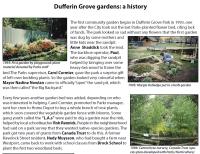
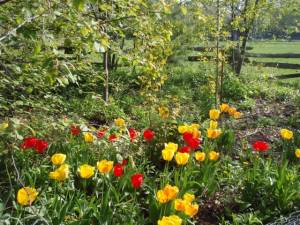
Dufferin Grove gardens: a historyThe first community garden began in Dufferin Grove Park in 1993, one year after the City took out the last Parks-planted flower bed, citing lack of funds. The park looked so sad without any flowers that the first garden was dug by some mothers and little kids near the sandpit. Anne Shaddick took the lead. The backhoe operator, Paul, who was digging the sandpit helped by bringing over some heavy 6x6 wood to frame the bed.The Parks supervisor, Carol Cormier, gave the park a surprise gift of left-over bedding plants. So the garden looked very colourful when Mayor Nadine Nowlan came to officially “open” the sand pit, which was then called “the Big Backyard.” read more >> Dufferin Grove Park Gardens in spring:posted April 23, 2008 See the new photo gallery. Better still, come to the park and smell the flowers! |
From the July - August 2010 Newsletter:
The big sugar maple beside the bake oven is half dead, and the park’s other sugar maples are fading fast as well. All over the city, sugar maples are in trouble. One theory is that they don’t like the warmer weather. At Dufferin Grove’s bake oven, and by the various footpaths, the soil compaction that comes with so many feet makes it worse.
But it’s not only sugar maples that are leaving the park. In every wind storm, a few giant branches from Norway maples and silver maples break off. Sometimes a whole tree comes down with a heavy crash. Is the park’s forest in trouble?
Maybe not. Here’s a bit of park tree history: Dufferin Grove Park is named for its trees. Photos taken a hundred years ago show lots of white pines and giant elms, as well as sugar maples and some flowering trees. In the 1930’s, the park became known all over the city for its horticulture – for its trees and shrubs as well as its beautiful flowerbeds. In the 1950s, many Norway maples were planted, although around the same time, most of the trees in the northeast quadrant of the park were cut down to make room for a sports field. (Before that, the central grassed area of the Dufferin Race Track across the street was often used as a sports field when the horses weren’t running. But in 1957 the race track was sold to make a mall. That sports field gave way to shopping.)
So the sports field was established in the park instead. The Norway maples in the rest of the park grew fast. The elms began to die off, though, because of Dutch elm disease, and the white pines gave way to silver maples, linden trees and ash. The flowerbeds were gradually eliminated (the last city flowerbed was removed in 1992, to save on gardening costs). In the late 1990s, half a dozen oaks and three white pines were planted south of the field house and north of the rink. Meantime, various park friends, after consultation with the City’s horticulture staff, began planting small beds of native species that included trees as well as shrubs.
There was no more tree planting by the City until 2007. That year, a City contractor was hired to plant 42 new trees all over the park, mostly various kinds of oaks, maples, and Kentucky coffee trees. But that was also the year of the drought and – therefore – it was the summer of hoses and mulch piles everywhere, as the park’s recreation staff worked with volunteers to keep the new trees alive despite six weeks without a drop of rain. Almost all those trees made it, and are thriving now.
In 2008, a City contractor planted two “little forests” of native species trees and shrubs near Dufferin Street. These plantings were part of City Council‘s big program of doubling Toronto’s tree canopy. Many people wondered why the plantings were so dense, all jammed together. This year, when city forestry developer Uyen Dias came to have a follow-up look at the two “little forests,” she said she was astonished at how well they had grown. The reason the plantings were so dense, she said, is that there was an assumption that many of them would not survive the first year.
But the land near Dufferin Street lies in the former Garrison Creek hollow. It’s fertile and moist. All the trees in the little forest flourished and most have tripled in size in two years. Meantime, the Norway maples around the wading pool and the sandpit seem to have made use of all the extra water coming their way, and with their enormous branches they are giving wonderful shade despite hitting 50.
So the trees being lost to old age or climate change are being replaced by thriving young trees, and it looks like the park can retain its name. However, the bake oven area will soon be without shade. It may be time to talk about Gene Threndyle’s suggestion: to make an area of flagstones and a simple shade arbour there, maybe with a low wall, to define the outlines of a park oven café. Food for thought.
From the June 2010 Newsletter:
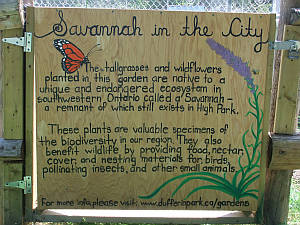
From garden-club coordinator Rachel Weston: “We had the opportunity to partner up with Clement Kent and his Pollinator Gardens Project (check out his blog: http://pollinatorgardens.blogspot.com/) who donated some plants to start one up and helped us plant as well. We have an awful lot of fabulous native species growing at the park already, but these new arrivals are exciting because they are especially attractive to birds, butterflies (and butterfly larva), bees and other insects that we need to keep the whole pollination scene abuzz (so to speak).”
The park’s “garden club” is open to everyone. They meet on Wednesdays and Sundays, and work in the park gardens together. To find out more, e-mail gardens@dufferinpark.ca.
A forestry crew came and sawed up all the wood; they took most of it away but brought some up to the woodshed for storage until it's dry enough to burn in the bake ovens.
From the April 2010 Newsletter:
As usual, everyone is invited to learn and share gardening skills during the drop-in gardening times, held between once and twice a week from spring to fall. This year, program staff Rachel Weston will work with volunteers to add some new native plants, and Leslie Lindsay and Heidrun Koepff will join Anna Bekerman in coordinating the vegetable gardens. To get weekly messages about gardening times, send an email to gardens@dufferinpark.ca or call the park at 416-392-0913.
Related Websitesposted February 24, 2005 The Toronto Foodshare website has several pages about community gardening, such as:
Green Thumbs Growing Things Website posted March 25, 2004 From Green Thumbs website: Children's gardening and natural science activities are important, especially for children in our neighbourhood [Riverdale] who live in apartments with little access to green space. It's also about celebrating nature's variety and healthy diversity, which includes us humans who've come from all over the world to this downtown Toronto neighbourhood. General Interest Websites
|
Gardening StoriesThe Tomatoes of Bureaucracyposted March 25, 2004 [park gardening versus bureaucracy] Ever since 1974, the city has rented out allotment gardens. When we moved back in 1980 we put our name down. There were none left, but they said they'd call us if there's a cancellation. And there was one. We put the kids in the car and drove up to look. There it was, number 22: one plot in a tract of thirty-six, bounded on the east by a four-lane road...Read more >> Garden Stories from our newsletters, 2000-2002[September 2000] Gardens: This year the plentiful rain started the gardens off well, and of course the efforts of Arie Kemp yielded wonderful results, as he grew the most striking flowers from seed all over the park. Arie collects seed from the best stands of flowers that he can discover on his bike rides around the city. Read more >> Newspaper Clippingsposted October 9, 2004 Now Magazine Turning Tomates Into Sauce By Kyla Dixon-Muir. Mentions Dufferin Grove Park Garden, and our own work with bureaucracy. |